Imagine one morning waking up to an email invitation from your dream tech company. The interview is for 3 weeks. Your heart pounds. So, you know that the technical screening will be very much focused on Data Structures and Algorithms (DSA) – the puzzle-like coding problems that tech giants use to filter candidates.
Where do you go to get ready? For millions of software engineers around the world, the answer is LeetCode.
Before you can even write a single line of code, reverse a binary tree, or optimize a dynamic programming solution, you have to pass the very first gate: the LeetCode login.
Logging in to a website seems like a simple task. But even minor friction points, such as missing verification codes, authentication timeouts or third-party sync issues can throw a wrench in your study flow. This guide will walk you through everything you need to know about the LeetCode login interface, adding your favorite languages such as Java, troubleshooting common lockouts, and building your profile to attract top recruiters.
1. How to sign in LeetCode ? (A Step-by-Step Breakdown)
You should be able to access your workspace in under 10 seconds. LeetCode provides a few convenient ways to get to your dashboard, whether you want to set up a new account or connect an existing online identity.
The direct approach: Email and password
If you want your professional learning to be separate from your personal social media, the best bet is to create a separate LeetCode account.
Go to the official website at leetcode.com. Look in the upper right hand corner of the homepage and click the Sign In button.
- Type in the email address you used to sign up or the unique username you created at that time.
- Enter your secure password.
- Click the green Sign In button.
The Modern Way: Third-Party Authentication (OAuth)
LeetCode works with popular external platforms so you don’t have to remember another password. On the login page, under the classic credential fields, you’ll have the iconic brand badges. You can instantly sync your account with:
- GitHub: Highly recommended for coders. It connects your problem-solving hub directly to your public code repositories.
- Google: The quickest option for 1-click authentication.
- LinkedIn If you are actively job hunting, LinkedIn is a great source because it syncs your practice dashboard with your professional networking profile.
- Facebook: A second rate social alternative.
Clicking any of these icons will open a secure pop-up window to ask permission to share basic profile information (eg. email address) with LeetCode. Confirmed, then inside you are redirected.
2. LeetCode sign in page navigation
Let’s take a look at what happens behind the scenes when you access the platform.
worldwide and regional kinds
Depending on where you live, you may be interacting with a variety of localized servers. The main international domain is leetcode.com and covers vast majority of engineers around the world. But LeetCode also operates a very niche, standalone regional site for mainland China, at leetcode.cn.
Important Note: Accounts, problem histories, premium subscriptions, and community contest rankings do not transfer smoothly between the global platform and the Chinese regional site. If you see a “Account Does Not Exist” error all of a sudden, double check that you are pointing your browser at the right domain before trying to log in.
Day One: Setting Up Your Work Space
Once you get through the credential gate you are presented with the main dashboard. This screen can be very intimidating for the non-technical user or a novice coder. Don’t worry, Problems can be found in the top navigation bar.
Click here to open the legendary problem matrix. You can instantly filter coding challenges by difficulty levels:
- Easy: Good for warming up and learning basic syntax rules.
- Medium: The sweet spot. This is where 80% of real tech interview questions are from.
- Hard: Challenging algorithmic puzzles to test your spatial reasoning and technical optimization limits.
3. Deep Dive: Login with LeetCode Java Integration
Java is a dominant force for engineers working in enterprise computing, banking platforms and large scale android applications. When users search for “LeetCode login Java”, they generally want one of two things, to optimize their platform environment to write Java code or to know how the LeetCode backend works for secure token session using Java technologies.
Configure Java in the Code Editor
You don’t need to install complicated development kits (like the JDK) on your physical computer to solve problems. LeetCode executes all programs in secure cloud environments.
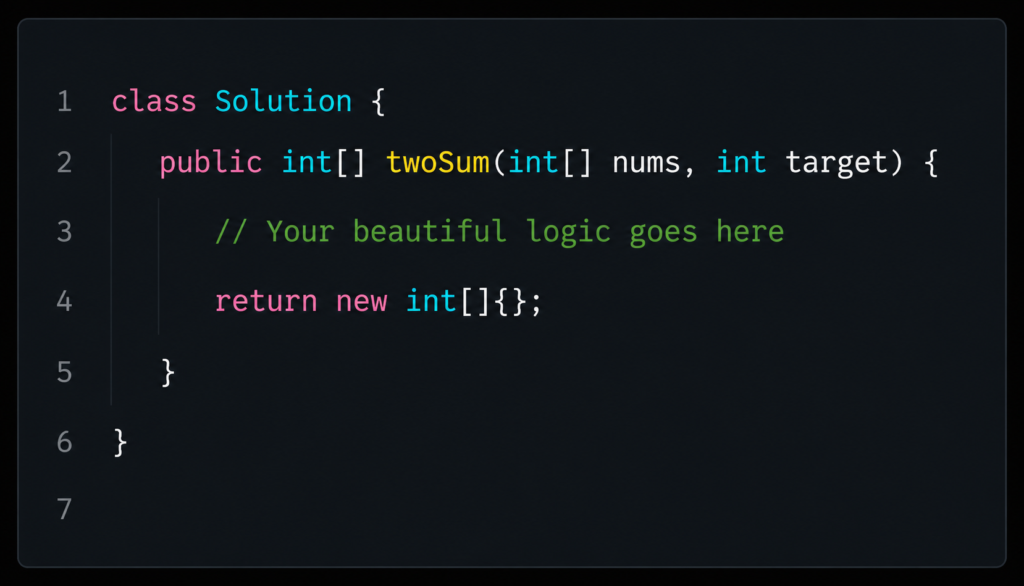
After you click on a problem (say, Two Sum), check out the top-left corner of the built-in code editor pane. You’ll see a drop down list with dozens of programming languages to choose from. Click on it and choose Java.
The editor will populate immediately with a standard code boilerplate structure:
Real World Example: Tracking a Session Token
To make this concrete for a non-technical reader, let’s break down what happens immediately after your successful LeetCode login.
Imagine that you are entering a high security office building. The receptionist gives you a temporary visitor’s badge instead of checking your ID card each time you walk through a door, step into an elevator or get a latte. As long as you have that badge, you’re good to go.
That visitor badge in software architecture is called a Session Token or a Cookie. If LeetCode’s authentication systems were developed using Java frameworks (e.g. Spring Security), the server-side process follows a very strict sequence:
Credential Submission: You provide your password on LeetCode login page and click submit. The browser wraps up this text securely and sends it down the wire.
Database Verification: The Java security layer intercepts the request, hashes your password input and compares it to the encrypted password stored within the database.
The Badge Creation (Token Generation): If the credentials match, the server creates a secure, unique string of characters called a Session Token (e.g., a JSON Web Token).
The Hand-off (Browser Storage) The token is returned to your browser and is silently stored inside your local cache. Each time you submit a coding solution, your browser automatically attaches this token to prove you are authorized.
4. Resolving Login Issues & Error Messages
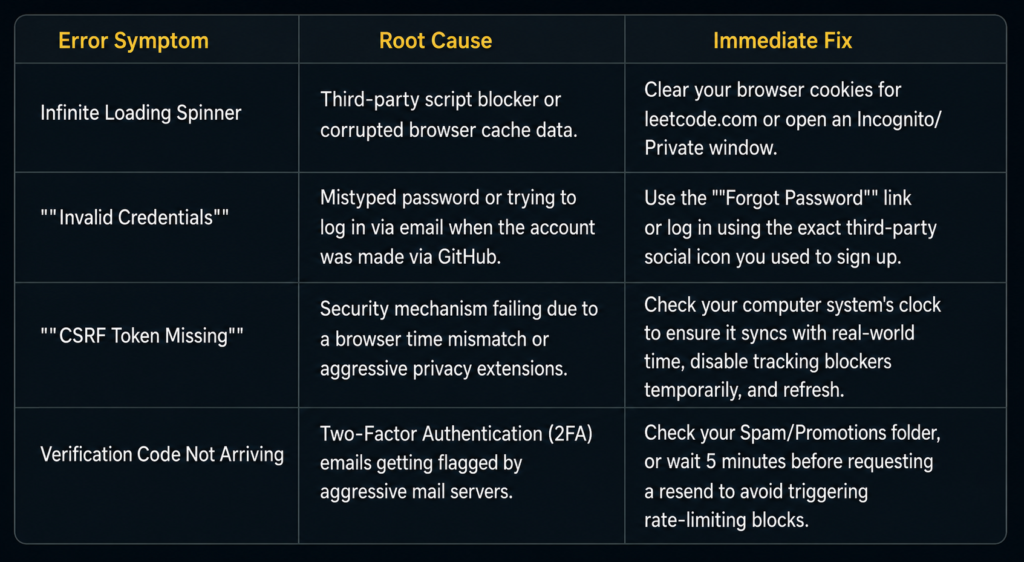
There’s nothing worse than being mentally prepared to solve complex puzzles, but being stuck on a loading screen. If you get errors in the login phase, use this diagnostic matrix to solve them in a flash.
5. Developer Best Practices for Secure
Your LeetCode profile is an essential part of your digital portfolio as a software engineer. Someone can break your streak of daily logins, erase custom code solutions, or mess around with your forum posts if they get into your account without permission. Here are some important security habits for securing your workspace:
Enable Two-Factor Authentication (2FA): Go to your account settings panel and turn on 2FA. That means you will have to enter a temporary code sent straight to your phone or authentication app, alongside your normal password. Even if someone cracks your password, they won’t get past this second line of defense.
Audit Connected Third-Party Accounts: If you originally linked your account through an old college GitHub profile or a social account you rarely use anymore, switch to a modern, highly secure primary email credential.
Do not ever copy paste internal config files, personal email footprints or session details hidden inside your browser url strings when discussing solutions in LeetCode’s forums. Do Not Use Public Pastebins for Code:
6. The Developer Portfolio: Personalizing Your Dashboard
Once you are safely logged in, remember your profile is a public-facing resume. Tech recruiters at the highest level often scan LeetCode leaderboards for underground engineering talent.
Complete your public card to maximize your professional footprint:
Add your socials Add direct links to your personal portfolio website, Github page and LinkedIn profile.
Show Off Your Badges: Take part in weekly and bi-weekly coding contests to win digital platform badges (e.g. Knight or Guardian). Display them proudly in your avatar frame.
Show Off Your Streaks: Consistency speaks dedication. Keep a daily problem-solving streak to demonstrate to hiring managers that you have grit and a continuous learning mindset.
10 Must-Read FAQs About LeetCode and Coding Royalty
To increase your knowledge, let’s take a look at ten of the most popular questions, from how the platform works to fun trivia about the world’s most successful computer programmers.
Q1: How do I recover my LeetCode account if I forget my password?
In case you forget your credentials, go to the main login page and click on Forgot Password. Please enter the email address associated with your account. LeetCode will email you an encrypted password reset link that is valid for 24 hours. Click on the link, choose a new password and log in again.
Q2: Is LeetCode free to use? Do I have to pay to log in?
LeetCode is free to use. Anyone can login and access over 2,000+ programming questions, community discussion boards and standard coding contests for free. They have a paid LeetCode Premium subscription that unlocks company-specific interview filters (e.g. questions specifically asked by Google or Meta in the last 30 days), faster code execution queues, and mock interview assessments.
Q3: Is it possible to use LeetCode on multiple devices simultaneously?
Yes, you can be logged in to your account at the same time on a desktop browser, laptop and mobile device. However, to ensure ongoing security and to prevent account sharing (particularly for Premium tiers), the system may initiate an email verification check if it detects concurrent active login sessions from IP addresses in different geographical regions.
Q4. Who is the best coder in India?
Who is the “top coder” depends on whether you use rankings from Competitive Programming platforms or algorithmic contests. But the undisputed world champion is Gennady Korotkevich, globally known as Tourist.
Legendary coders from India like Ananya Kumar (who had phenomenal international rankings during his competitive run) and Aman Goel are well known. Elite Indian competitive engineers on LeetCode such as Kashyap Sukshavasi and Agnibha Chakraborty regularly rank among the best in the world with platform scores of around the 3,000+ mark, ranking them among the best of the global problem solvers.
Q5: Who is the richest programmer in the world?
If you were to judge personal wealth purely on the basis of creating iconic tech software, Elon Musk and Bill Gates would be right at the very top of the world’s richest people lists.
Musk made his initial fortune by literally writing the code for the backbone of software platforms like Zip2 and X.com (now PayPal), and the money bought him the runway he needed to start SpaceX and grow Tesla. Bill Gates co-authored the foundational interpreters for early computer systems and launched Microsoft Windows. He built a multi-billion-dollar empire.
Q6: Can I change my username on LeetCode after I have created an account?
Yes, but you have to do a good planning. LeetCode makes it easy to change your nickname in the Account Settings dashboard. But you can usually only change it every few months to prevent abuse of the system and breakages in historical contest leaderboards.
Q7: I Have Made Too Many Wrong Attempts To Log In To My Account. What can I do?
This is an automated safety lock to protect your account from brute force password guessing attacks. Hitting this wall will temporarily ban your account for about 10 to 30 minutes. Go away from the computer, drink a glass of water, let it cool down and try to log in with a clean slate, or ask for a password reset link.
Q8: Does LeetCode track my physical location when I login for a contest?
LeetCode strictly tracks network IP addresses for basic security monitoring, to prevent fraud, and to ensure automated bot accounts are not undermining global ranking leaderboards. It doesn’t track your core physical coordinates or read personal background tracking metrics .
Q9: How to delete my leetcode login info and history forever?
If you decide to stop programming altogether, you can remove your digital footprint. In the Account Settings panel find the Delete Account option. Proceeding with this action permanently deletes your entire historical progress, earned badges, solved code files, and custom profile attributes. This is a non-reversible operation.
Q10: Which programming languages are available on LeetCode after I log in?
LeetCode is very language agnostic. Once you are logged in, you can solve problems in a huge list of popular languages including Java, Python, C++, C, JavaScript, TypeScript, Go, Ruby, Rust, Scala, Kotlin, PHP, Swift and even specialized data tools such as SQL and Pandas.
Summary
LeetCode login page isn’t just a tech website login page, it’s the entrance to your professional engineering career. Configure your account correctly, pick your workspace language like Java, enable strong 2FA protection, and fine-tune your public profile card, and you’re on your way from casual coder to interview-ready engineer.
One problem at a time, consistent, and let those green checkmarks pile up!

Leave a Reply